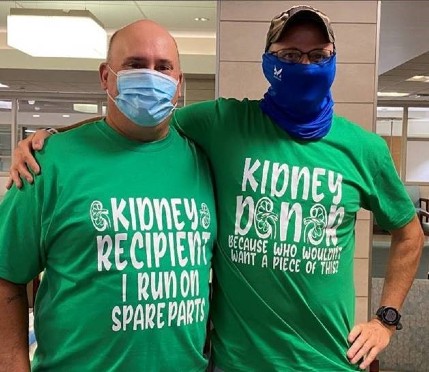
In 2007, Greg Randolph had just retired from the Oklahoma Army National Guard after 24 years of service when he was diagnosed with a degenerative kidney disease. It was discovered during his last official physical exam with the military.
Through medication, he was able to manage the condition until recently when his physician began using words like ‘dialysis’ and ‘transplant’. “It’s one thing to talk about kidney deterioration and dialysis,” says Randolph. “But when you hear ‘transplant’, it kind of punches you in the gut because that is something you’ve been trying to avoid for 14 years.”
Randolph was referred to the
Nazih Zuhdi Transplant Institute at INTEGRIS Baptist Medical Center in Oklahoma City. He was placed on the transplant list and the hunt began to find a suitable donor.
“I had known Greg for a few years because our wives were friends. His wife, Gerri, had actually helped us through the adoption process of our great niece,” says Chris Buck. “And being an active National Guard member myself, we had a lot in common and got along really well.” But he admits, “I had never even considered being an organ donor before, because I guess it’s one of those things you never even think about until someone you know needs it.”
Greg remembers their first conversation on the subject well. “We were just sitting in the backyard eating hamburgers and hot dogs when Chris is like ‘I’ll give you my kidney’. I didn’t really know what to say. How do you react to such selflessness?”
Turns out, Chris and Greg were a perfect match. The only hurdle was that because of his active duty status, Chris needed to get permission from the highest level in Washington D.C. - the Surgeon General of the Army. Once that was achieved, the process ran smoothly. “I think it was meant to be for sure,” says Buck. “Just the way everything fell into place so easily.”
Randolph agrees, “I personally attribute this to being a part of a miracle. To have somebody who cares enough about somebody else’s life to take out a major part of their own body and freely give it away – there are no words to explain that as a recipient. It’s the perfect example of one Guard member giving to another Guard member.”
 E.N. Scott Samara, M.D.
, the Medical Director of Kidney Transplantation at Nazih Zuhdi Transplant Institute, performed the transplant with his son,
Shea Samara, M.D. “I have been doing kidney transplants for over 30 years. I continue to be so grateful for the friends and family who unselfishly come forward to donate a kidney,” says Samara. “Greg was able to receive Chris’ kidney less than a year after being listed for a transplant, while the typical waiting time for a deceased donor is generally three to five years.”
A living-donor kidney transplant is when a kidney from a living donor is removed and placed into a recipient whose kidneys no longer function properly. Only one donated kidney is needed to replace two failed kidneys, which makes living-donor kidney transplant an alternative to deceased-donor kidney transplant. About one-third of all kidney transplants performed in the U.S. are living-donor kidney transplants. The other two-thirds involve a kidney from a deceased donor.
“The beauty about a living donor transplant is that no one has to die for the miracle to occur,” states Samara. “Each day, 12 people die waiting for a kidney transplant. Just imagine how many more lives could be saved if more people would consider being a living donor.”
Click here to learn more about living kidney donation.


