


Julie “JJ” Jarvis, 46, very nearly cancelled her annual screening mammogram in 2024. Today, she thanks God and her expert team of caregivers at INTEGRIS Health that she didn’t.
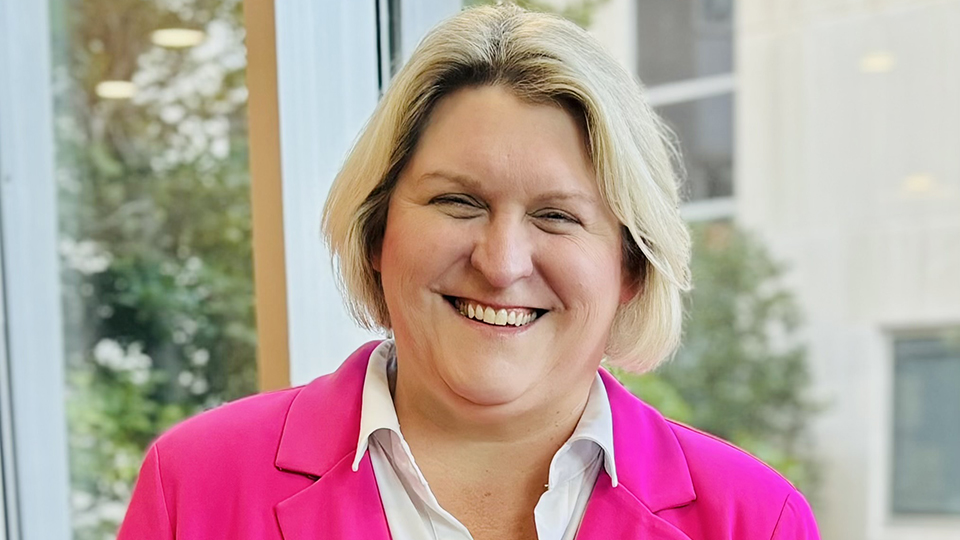
Julie “JJ” Jarvis, 46, very nearly cancelled her annual screening mammogram in 2024. Today, she thanks God and her expert team of caregivers at INTEGRIS Health that she didn’t.
After a traumatic knee injury sustained last year, JJ had suffered through a lot of pain, hospital visits and surgeries. When the time for her annual mammogram came around, she frankly didn’t immediately feel like going to her appointment.
“The truth is I almost cancelled my screening,” says JJ. “But it takes 10 minutes to do and I’m glad I went.” As a manager of operations at the INTEGRIS Health Cancer Institute and manager of the Troy and Dollie Smith Wellness Center at INTEGRIS Health, JJ knows firsthand how important early detection is when it comes to treating patients with breast cancer. Had she waited a year, her prognosis might have been much worse.
After getting her screening mammogram in May of 2024, JJ received a call from her radiologist to come back in for a diagnostic mammogram for further examination. She then received the call with news no one wants to hear: You have breast cancer. Working with her oncologist, JaNae Clapp, M.D., JJ learned she had been diagnosed with invasive lobular carcinoma (ILC) in her right breast.
“Everybody who hears ‘cancer’ is frightened for their life,” says Clapp, who is board certified in medical oncology and practices at the INTEGRIS Health Cancer Institute. “As an oncologist, it’s critical for my patients to understand the many treatment options available to them and that we will be with them every step of the way.”
Thankfully, getting her regularly scheduled mammogram meant that JJ’s cancer had been caught early, and the tumor had yet to metastasize. While screening doesn’t prevent breast cancer, it does allow doctors to find and treat the cancer at an early stage. Earlier treatment leads to more effective results. For ILC, the five-year survival rate is nearly 100 percent when treated early. Compare that to a rate of 22 percent if treatment begins after the cancer has metastasized.
“We work closely together to create a consensus and a customized treatment plan for every cancer patient,” says Kiran Prabhu, M.D., JJ’s radiation oncologist. “The word cancer is always frightening to patients and their families, but having cancer is no longer a death sentence. With the treatment modalities and cutting-edge technology options we have available for patients today, early-stage cancers are very curable.”
JJ underwent a lumpectomy in June. Her surgeon, Nicole Sharp Cottrell, M.D., emphasizes how critical an annual screening can be. “It’s so important to get our mammograms every year so that if there are any changes or suspicious findings, we get it detected, diagnosed and treated early,” says Sharp, a board-certified and fellowship-trained breast surgical oncologist at INTEGRIS Health Medical Group Breast Surgery. “When it comes to treatment, what works for one person isn’t always the best approach for other people. I like to work with my patients to develop a treatment plan together.”
As Sharp also points out, breast surgery is only one aspect of breast care, and particularly for breast cancer patients, there are a variety of specialists working together to make sure to provide patients with comprehensive care, including radiologists, pathologists, oncologists, genetics counselors and even behavioral health specialists and social workers given how impactful the diagnosis can be on every aspect of your life.
After surgery, JJ received four weeks of radiation treatment. She is now on ovarian suppression and an aromatase inhibitor to keep the cancer from returning. Sharp describes how this line of treatment can help reduce the risk of recurrence in the future. The aromatase inhibitor works by lowering estrogen levels and inhibiting the production of aromatase, an enzyme found in fat tissue.
Moving forward, JJ will get a mammogram every six months as well as an MRI to keep an eye on any possibility of the tumor coming back.
In her work, JJ often sees patients like herself, who experienced no symptoms but received a positive diagnosis of breast cancer. “Go get your mammogram,” JJ advises. “It saved my life. The test itself takes minutes but can make a huge difference in your life.”
“I tell my patients that faith, family and friends are what is needed to get through this diagnosis and that nobody fights alone. It’s not just a personal battle, but one that calls for the strength of everyone around you. With the unwavering support of family, friends, colleagues and a dedicated medical team, you find strength in moments of weakness and hope when it seems hard to find. Every step of the journey, you are uplifted by the care, love and encouragement of those who walk beside you.”
To schedule your mammogram, call 855-MY-MAMMO (855-696-2666) or talk with your doctor for more information.


